Beginner’s Mind

In the beginner’s mind there are many possibilities; in the expert’s mind there are few.

-Shunryu Suzuki, Zen Mind, Beginner’s Mind

This week I began a page one rewrite of my mariachi book. I know, I know. I’ve been working on this book for three years. The writing experts would’ve told me to give up and move on to more profitable pastures. Actually, three years ago I would’ve told myself the same thing.

But the last eight weeks (and being dumped by my agent) have shown me the number one reason why this book has yet to fly. It’s not the fault of my agents or readers. It’s not because the market sucks or Mercury in retrograde. It’s because I worked on it with the mind that I knew what I was doing.

I’m not saying that this journey has been wrong. I’m not blaming anyone or anything or labeling my decisions as mistakes. In fact, I’m beginning to waver on the concept of right versus wrong and adopting the idea of “what is.” (Note to Karen Maezen Miller: you’re rubbing off on me, comadre!) For us Westerners, specifically for us writers striving to become published/acknowledged/adored, the idea of “it is what it is” is wrong and scary and exclusive to authors with a lot of money and mileage on the best-seller lists.

Through all of May and June I wrote a pilot script, a series treatment and then a spec script. I began those projects never having taken a TV writing course or having written a script for TV. (Although I’d taken screenwriting courses in university, that was 15 years ago and I’d lost those class notes!) How did I do it? Well, I did it by pinching my nose and jumping in. This journey turned everything I had believed in as a writer upside down. I believed in business plans, outlines, the three-act structure and 10,000 hours of practice. I believed that I had to get away from my beginner’s status as quickly and efficiently as possible. I even believed that my producer should have hired an experienced screenwriter instead of a beginner like me.

But then I remembered what Nora Roberts had said in one her chat sessions back in 1994. Someone asked if she ever got over the fear of writing a new book. Nora, who has written something like 120+ books in her career, replied, “No. Starting a new book is like starting all over again.”

At the time, I had no idea what she was talking about. I thought it was nice of Nora to say that to all us beginners, but now I know what she meant and it freed me to write the pilot, spec and treatment. No matter how many books or screenplays I may end up writing, I will always be a beginner. It’s not scary or discouraging. A beginner’s mind isn’t hemmed in by business plans, right vs. wrong, plot-driven or character-driven or the three-act structure. A beginner’s mind damns the consequences and is open to spontaniety and “what if.” Isn’t that what we writers do?

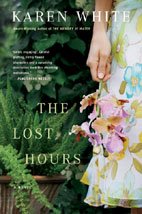
Between the Pages with Karen White

Give me a story with a plucky heroine in a mysterious house surrounded by trees draped in Spanish moss and I’m one happy girl. It’s enough to make me wonder if I was a Southerner in a former life. Nonetheless, Karen White delivers the goods in her latest novel, The Lost Hours. Its a powerful story of redemption and how the past still sends ripples into our present day lives. But man is this story powerful. When I reached the denouement, I had to put the book down and hold my Little Dude in my arms.

Please welcome Author Karen White!

Chica Lit: The Lost Hours is a story of healing about a heroine who wants to bury herself alive and a mystery that probes into a very ugly part of U.S. history. How challenging was it to write and how did you keep going when it got rough?

Karen: I always start out with flawed characters who have a lot of growing and learning to do. When I put them in tough situations, I feel like a mother with a toddler helping him to walk for the first time. We have to suffer with them through the falls and stumbles, but we’ll all be better off with the end result. So, when my characters are suffering, I know it’s for a good reason and they will learn and grow from the experience. I still cry and/or laugh with them through some of the scenes–which always takes a lot out of me, but that means I’m on the right track!

Chica Lit: Why do you think Southern Gothics are so fascinating?
Karen: I don’t know about other readers, but for me it’s simply because it’s such familiar territory! I come from a long line of Southerners (my dad’s family has been in the South since the French Revolution) and I’ve got a very ‘interesting’ family tree. I don’t want to call them crazy , but there are characters and settings that I’ve experienced in real life that have certainly fed my fascination for “Southern Gothic” and inspired quite a lot of my own writing.
Chica Lit: What comes first: character, theme or story idea?
Karen: Always, always, always the character. Everything else stems from her and what she needs to learn.
Chica Lit: How do you know when a book is done?
Karen: When I’ve reached my deadline. Just kidding! When I feel as if I’ve tortured my characters enough and they’ve learned what they’re supposed to–that’s when I know the book is done.
Chica Lit: What’s next?
Karen: In November, The Girl on Legare Street (the sequel to The House on Tradd Street) will be released. I’m contracted for two more books in this series to be released in 2011 and 2013. In the meantime, I’ll have two new ‘southern women’s fiction/Southern Gothic novels out in spring of 2010 and 2011, and somewhere in there (we haven’t figured out exactly when) will be the re-written and re-released Falling Home, originally published in 2002.

All this will be accomplished if my children leave me alone and my head doesn’t spin off my shoulders!

To learn more about Karen and her books, please visit her website!

Update

After my last post, many of you wrote and asked me not to give up book writing. Not to worry. I’ll never stop writing books. They’re just going to take longer than usual. Today I turned in a pilot script and series treatment and on Monday I’ll start writing a spec script that is due at the end of June. In July I plan to go back to Aracely and whip her into shape for the fall. That’s the plan and I’m stickin’ to it.

In other news, I did an awesome interview with Chef Daisy Martinez last week. It will appear in the July/August issue of Latino Future magazine. Typically my interviews with celebrities are pretty cut and dry. But Daisy was special. She’s one of those women who’s done it all. She’s sustained a loving marriage, raised a family of four, acted in commercials, matriculated from the French Culinary Institute and is now a Food Network chef, magazine columnist and author.

Some pretty amazing opportunities have come my way recently (hard to believe after my last post but its true). Being me, I was freaking out because of the huge changes these opportunities would bring to my family. I mean, I’d die if my son ever had to call my assistant to schedule himself on my calendar. But then I talked to Daisy, who in spite of all that she does, puts her family first. When I asked how she does it all, she said the following which I printed and stuck it above my computer:

“I’m one of those girls that shows up, you know? When I have a job to do, I get it done.”

Every day since that interview, I step into my office and tell myself: I’m showing up, doing the work and then when I’m done, I’m walking out of here to do what I gotta do with my family. I can’t tell you how amazing that kind of attitude has been. My output is off the charts and while I know it won’t last forever – these things ebb and flow as they should – I’m really enjoying the flow! So if she’s reading this, thank you Daisy!

I hope y’all have a rockin’ weekend.

Cheers,
Mary

Thought of the day


Today Lenny Kravitz leaked a nekkid photo of himself. Last week, Rhianna photos appeared online. In 1952, Marilyn scored big when her topless photos launched Playboy. Apparently when a reporter asked what she had on during the photo shoot, she replied, “The radio.” From that moment on, Marilyn became a bona fide star.

Celebrties and their nakedness is nothing new. The photos appear out of nowhere, “experts” appear on TV and in newspapers to wonder outloud if the photos will ruin the celebrity in question and then before you know it, the naked girl or guy’s new movie or TV show or CD is for sale.

Nudity seems to turn a red hot career into a white hot career which leads to my thought of the day: would my books sell better if I leaked a nude photo of myself?

Today is Cinco de Mayo?

I’m a bad Mexican. I forgot that today is the day Mexicans won the Battle of Puebla. I think.

In celebration, I have this video to post in honor of my favorite Mexicana warrior:

[youtube=http://www.youtube.com/watch?v=YVLJcBsD__E&hl=en&fs=1]

Makes you wanna go kick some ass, huh?

Between the Pages with Susan Meissner


When I read The Shape of Mercy by Susan Meissner, I got lost in the story and forgot all about being a writer. Lately I’ve been a real complainer about books that lack stories and certain fiction titles. But The Shape of Mercy reminded me that my love of books – especially those which take risks with prickly characters and pop back and forth between the past and present – is much stronger than the things that irritate me. As soon as I finished her book, I had to have her on the blog and talk about what inspired the story, the surprises she encountered on the way and the world she created for her characters.

Please welcome Susan Meissner, author of The Shape of Mercy.

Chica Lit: How did the idea for The Shape of Mercy come to you?

Susan: When I was in junior high, I was in play called To Burn a Witch. I played the role of an innocent young woman accused of witchcraft. The play opens with my character sitting in a jail cell with other innocent young women from her village also convicted of witchcraft and facing the stake. When my character realizes she can save herself by pretending to be bewitched, she begins to scream that one of the other girls in her cell – a friend, actually – is tormenting her. My character is led away to freedom and the woman she accused falsely is led away to her execution.

I had forgotten being in that play until I read a newspaper article a couple years ago about a woman who was petitioning a Massachusetts court to exonerate her great-times-eight grandmother. This ancestor of hers was accused and convicted of witchcraft during the Salem trials, was released when the hysteria ended, but whose name was never cleared. I was reminded of how it felt, even just as an actress, to be accused of being something I was not – and the far worse feeling of accusing someone I knew was innocent. These people who died in 1692 Salem were all innocent. They all died refusing to confess they were in league with the Devil, even though their lives would have been spared if they had. They held onto truth to the point of death. That, to me, is incredibly inspiring.

Chica Lit: Could you talk about your writing process?

Susan: The writing process for me begins with something like what I just shared: Ordinary people who I can relate to experiencing something extraordinary and faced with a choice. The Shape of Mercy is about a college student from an affluent family who takes a job she doesn’t need transcribing the 300-year-old diary of a young victim of the Salem Witch Trials. I wrote the diary first; before I wrote anything else. After reading several different kinds of books on the Salem Witch Trials (they are all listed in the back of the book), I felt ready to step into 1692. I interview my characters before I write their story, so I had already had several imaginary conversations with Mercy Hayworth before I began to write her diary. I knew how she was wired, what she was good at, what she feared, what she was willing to do for the people she loved. After I had written the diary, it felt real to me. And I wanted it to, because it had to feel real to Lauren, the college student. The Shape of Mercy is about how Lauren’s character develops, and it’s all based on the discoveries she makes while she’s transcribing Mercy’s diary.

Chica Lit: Which character surprised you the most?

Susan: I would have to say it’s Abigail who evolved into a character I actually grew to care about. Abigail is the 83-year-old recluse who owns the diary and hires Lauren to transcribe it. Abigail was always going to be kind of a hard-souled sourpuss whose own disastrous choices made her the way she was. She was to personify regret so that Lauren could see what becomes of a person who makes decisions based on self-preservation alone. But the more I got into the story, and into her stony heart, the more I saw a woman who wasn’t past getting through to. She became someone I could redeem. Nice surprise.

Chica Lit: How did your journalism career help and/or hinder you as a novelist?

Susan: I have come across only good things that have transferred over from my days as a newspaper editor. Journalism is all about word economy, hooking the reader with the first sentence, saying much in a short amount of space, choosing powerful nouns and verbs instead of cosmetic adjectives and adverbs, and of course, sticking to a deadline. I am amazed at how much journalism prepared me to write fiction. And I know that sounds a like a joke! But it’s true. Go figure.

Chica Lit: In a way, you’re continuing The Shape of Mercy through a blog written by the characters. Will you write a sequel or continue the blog?

Susan: The blog, which is found here, has been a wonderful way to keep the characters alive.

More than once I’ve finished reading a novel where I’ve connected deeply with the characters and found myself a little depressed when I turned the last page. It’s been like having to say goodbye too soon to people I’ve learned to care about. My goal is always to create characters that seem real. I want them to seem real to you and to do that they must seem real to me. This was especially true with the characters in The Shape of Mercy. I wanted Lauren, Abigail, Esperanza, Raul, Clarissa, – and even Mercy – to keep breathing, to keep talking to me, prodding me even though the book was done. It’s true that the characters write the posts and I wouldn’t exactly say it’s an online sequel. The posts are emails between Lauren and Raul, advice from Clarissa, stories and poems from Mercy’s recovered storybook, insights on life and literature from learning-to-let-go-of-regrets Abigail and kicky recipes from Esperanza, Abigail’s housekeeper. It has a sequel-type feel and I like that because I have no plans to carry the story into another full-length book. I feel I told the story that needed to be told there. And I guess I will continue the blog until the story that needs to be told here is told!

Check out The Shape of Mercy or visit her website and blogs at www.susanmeissner.com.

The Unlikeliest Places

I better ‘fess up. When I get stuck or bored or lazy, I make the rounds of gossip sites. But my meanderings paid off when I learned about legendary singer, Chavela Vargas from Lossip.com.

Her ancient voice crackles from lost loves and alcohol. Even though she sings in Spanish, I feel what she’s singing about. Some things transcend words and to a writer that is humbling.

[youtube=http://www.youtube.com/watch?v=0gQ31m4Yt0s&hl=en&fs=1]

Subtext

This is probably somewhat illegal but what the hell. Anyway, have you ever talked to someone who repeats how happy/smart/humble they are? When that happens, I always wonder if they’re saying it to convince me, or themselves and then of course, my imagination conjures all sorts of lurid possibilities as to why. Unlike most four year-olds, a writer never grows out of the “why’s”.

This scene from Breakfast at Tiffany’s is pitch perfect in conveying subtext. It helps if you’ve seen the film in its entirety to appreciate Holly’s subterfuge, but Audrey Hepburn’s performance does a lot of the work for you.

Check it out and then have yourself a great weekend!

[youtube=http://www.youtube.com/watch?v=8eFvDlWDHMU&hl=en&fs=1]

Tone Deaf

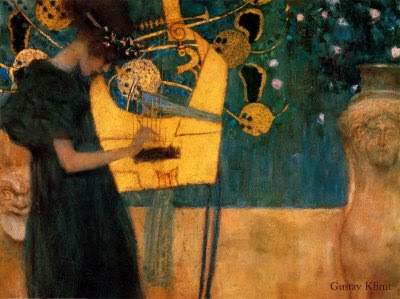
Musique by Gustav Klimt @ Art.com

The other day Ryan and I were talking about the books and scripts we’ve read lately. I had just come off a two-month reading dry spell during which I’d start a new book and then put it down at page 20, not caring what happened in the end.

Up till I had a child, my rule was never to leave a book unfinished. But I’m 35 now and in my family that makes me just shy of middle aged. My great grandma lived till she was 76 and my great grandpa and Grandma Mary stuck around till they were 88 … mas o menos (neither were forthcoming about their real ages). So compared to what I want to accomplish in this lifetime and my probable life expectancy, I don’t have a lot of time to waste.

Anyway, Ryan argued that the reason why so many movies fall short and why so many books go unfinished is that their authors are tone deaf when it comes to story. Even though many writers come up with great ideas and snazzy hooks, and possess enviable literary wit, they can’t move a story from point A to Z.

So when I think about the books that I’d given up on, I realized indeed they were tone deaf in story. In other words, nothing was happening except the protagonist complaining about his or her life. Or worse, I was reading an author who clearly loved hearing him or herself talk. Nothing was at stake and no one or nothing was in jeopardy and those my friends are the building blocks of a good story.

Now this isn’t a literary fiction versus popular fiction rant. Nor does it have anything to do with my constant irritation with books titled, “The Candyman’s Daughter” or “The Stinky Cheesemaker’s Wife.” I don’t think that you don’t have to be “genre-fied” to spin a rip-roaring yarn. For example, even some books that cultural connoisseurs have deemed literary fiction, tell stories. Check it out:

In Cold Mountain, a soldier is making his way back home and to the woman he loves. Inman is in constant peril and much is at stake.

In Water for Elephants, a young veterinary student joins the circus and falls in love with a married woman. On each page, Jacob’s life and that of an elephant are on the line.

In The Great Gatsby – it’s read in high school so it’s a certifiable classic literary novel – a man tries to woo the golden girl who’s married to a lout. Jay Gatsby risks his heart for idealistic love.

So recently I came across a book that lacked a story and I froze with terror that the dry spell had started again.

(By the way, I won’t name names because that’s cheesy and I don’t need attention so badly that I’ll risk your hate mail.)

Going back to the book … The character was cute but if you read chick lit, you’ve read her a thousand times over and better. The writing was fast-paced and in a few places quirky enough for me to crack a grin. And guess where it takes place? If you thought New York, you win!

I gave it up at page 7 even though:

  • A major publishing house bought and published it.
  • An editor, marketing/PR person, copyeditor, sales squad, cover artist and a cast befitting a Cecil B. DeMille epic worked on it.
  • You’ll find it on the tables at major book stores.
  • Many prominent women in media called it the best thing since their vibrator.

Okay, I made up the part about vibrators but you get the idea.

This book, out of thousands, was plucked for publication even though IT HAS NO STORY.

Seriously dude, that’s the problem. Too many people are story tone deaf and yet have the wherewithal – time and a laptop and in some cases, friends in high places – to write a manuscript that gets published. Trust me, I know. Having judged plenty of contests and having read some awesome work by the members of my former critique group, there are stories out there that can’t find a place at your local bookstore. They’re held off because (a) they’re not “high concept” enough (an over-rated ideal, let me tell you) or (b) publishers can’t take chances on stuff that’s not regency romances or vampires. (Dude, I do don’t get the vampire thing.)

But could someone become pitch perfect when it comes to story? Do you have to be “special,” or can you cultivate it?

Hmm. That’s a toughie. I guess it’s up to the individual – not that I’m claiming to have been born with great literary prowess …. just ask the people who proclaimed their hatred of my books on Amazon.com. But when it comes to story, I’m always learning by reading books and watching movies. I read plenty and preferably, beyond the confines of my genre.

When I’m lucky to find that special book or movie that make me forget that I’m a writer, I reread/rewatch it to spot how the author structured the story. I even take notes and ask myself the following:

  1. What does she reveal about the characters? But most importantly, how and when does she reveal what they’re trying to keep secret?
  2. How does she work characters against each other and create conflict that make me hold the book tighter, or lean forward towards the screen?
  3. Where are the pulse points of the story? (One could call them plot points, turning points … whatever floats your boat.

I’m not saying anything new about story telling, by the way. I think every writer knows these questions instinctively and through writing and rewriting and more writing and rewriting, you understand what you’ve been doing since you were playing make-believe as a kid.

So with that all said – oh, I feel like I could walk on air! – I’ve got some storytelling to do.