Guest Blogger: M.J. Rose

When I was three years old, I told my great grandfather things about his childhood in Russia that there was simply no way I could have known. He became convinced I was a reincarnation of someone in his past. And over time, after more incidents, my mother “a very sane and logical woman” — also came to believe it.

Reincarnation was an idea I grew up with that my mom and I talked about and researched together. For years, I wanted to write a novel about someone like my mother “who was sane and logical” who started out skeptical but came to believe in reincarnation. But I was afraid if I did people would think I was a “woo woo”weirdo.

I tried to start the book ten years ago after my mother died but I was too close to the subject and missed her too much to be able to explore it objectively. Every once in while the idea would start to pester me again but I still stayed away from it.

Then a few years ago on the exact anniversary of my momâ’s death my niece, who was a toddler at the time, said some very curious things to me about my mother and “things she really couldn’t have known — and the pestering became an obsession.

Josh Ryder, the main character has my momâ’s initials, her spirit and her curiosity and like her, he’s a photographer. But there the similarities end.When Josh starts having flashbacks that simply can’t be explained any other way except as possible reincarnation memories he goes to New York to study with Dr. Malachai Samuels — a scientist and Reincarnationist who works with children helping them deal with past life memories.

In the process Josh gets caught up in the search for ancient memory tools that may or may not physically enable people to reach back and discover who they were and who they are. I think of all my books, this is the one my mom would be the most proud of which is fitting since it’s really the one she inspired.

Please visit my website: www.mjrose.com for an excerpt, an interview with me about the book, a booktrailer and more.
****CONTEST ALERT****CONTEST ALERT****
Win a copy of M.J.’s new book by emailing me with “MJ Rose Contest” in the subject line. I’ll draw the name of the lucky winner on Sunday, Sept. 23, 2007. Enter now!

Leavin’ On A Jet Plane

Today I had a great day with the Little Dude. He threw one tantrum. (Only one!) We played under a gorgeous blue sky with a kicky wind blowing off the ocean. We picnicked and checked our tomato plant because it has a “baby” tomato and the Little Dude is convinced that it will be ready to eat any second now.

Tomorrow, I’m taking off for Phoenix to attend the National Hispanic Women’s Conference. I’ll be joining Margo Candela, Caridad Ferrer and Alisa Valdes Rodriguez to talk about Chica Lit. We’ll be signing copies of our books from 3:30 to 4:30 p.m. in the Expo Hall at the Phoenix Convention Center West Building. For information, go here.

Why The World Needs Chica Lit

Six years ago today, I came to work and did nothing but sit at my desk, trying to get on the Internet to find out what happened in New York and Washington D.C.

A week later I was laid off from my job. My husband walked out of our house, watching me as I pulled up. The neighborhood was still quiet but candles waited on porchsteps, waiting to be burned. I carried my box of stuf into the house, joining my husband at the front door. He didn’t ask me what I would do next because the answer was simple: I’d find a job. We’d be fine. Life would go on and I’d fall right back into step.
Six months later, I finished the first draft of a book that I had no idea would one day become part of the chica lit movement. I had no savings left in my account and took a job that paid me half of my former salary.
But looking back, I got kicked around. Not destroyed because the events of September 11th showed me what true loss was. But I was a little battered and bruised; uncertain and unable to sleep because one wrong move, one errant dollar spent and we’d be late in paying the phone bill.

But we recovered. The job markt reopened and I got a better job. My book had been revised and I shot off several queries to agents in hopes of selling it before my 30th birthday. In May of 2003, I got my issue of Latina magazine and in it was an excerpt of a book called, The Dirty Girls Social Club by Alisa Valdes Rodriguez.

When I read it, I forgot about the uncertainty of my immediate world and that larger, scarier one outside my door. I read one review that said the book was “okay” for a story with a happy ending. (Apparently the reader didn’t care for stories that gave its characters what they wanted.) To me, it was a life line that whispered everything would be okay and that out there, even if it was in make-believe land, women like me were winning.

Unlike that reader who deemed herself too good for happily-ever-after’s, there’s a world of women out there who wouldn’t beg to differ with her. They would simply go to the bookstore, hand over their hard-earned cash and read chica lit books during their lunch hour, commute or when their babies nap. They need to go into a world that resembles their world and yet, its a world where women like them win.

These women are grounded by family and friends (Sex and the South Beach Chicas). They are cleansed by tears of laughter and loss (Cinderella Lopez). These women take in deep gulps of breath to laugh at what life throws their way (Underneath It All). These women burn with the fire of determination to the point where they’re willing to do anything – even sell their bodies – for a chance to meet a long lost father and still, have a sense of humor about it (Dirty Blonde and Half Cuban).

The destruction and the lives all of us lost on that day were not in vain. Words and stories were awakened and fingers eagerly tapped on keyboards to give birth to chica lit. Back then we didn’t have chica lit on the bookshelves. Today, there are new stories and new authors waiting to be discovered.

Rather than dwell in loss, today I’m going to celebrate life and creativity. I’m going to dwell in gratitude.

On The Radio

Up till this morning, I’ve never had the experience of being an on-air expert and frankly, it was a little weird. I called in at 6 a.m. and listened to the conversation between the host, Mel and Ariel Gobert, author of Red Hot Revolution. Two commercial breaks later, I’m on and I’m still wondering how I can help Ms. Gobert market her self-published book.

So I did what I do best: I talked about myself.

But then a brilliant idea occurred to me. Maybe she should link up with a local reporter and take them on one of her blind dates. It could open up a discussion about women in their 50’s who have had careers, raised kids, etc., now entering the dating scene. My former editor would’ve given me a raise on the spot for an idea like that. In fact, I was starting to wish that I was a reporter so I could do the story!

However, my idea bombed. Frankly, I think it horrified her. Hours later when I was at the gym, I realized that that is one of the problems we face when pursuing our dreams. We say we want something and yet, we’re frightened of apprearing foolish. We tell the world and ourselves how much we want it but we won’t do the things that terrify us like, finish a book, find a new man or lose weight.

In a way, I feel lucky to be a foolish person, or a person who doesn’t give a shit if people think I’m foolish. A few years ago, one of my husband’s colleagues turned to me and to my face said, “I read your book and I was so embarassed for you. Those love scenes were so…”

She shuddered as if she’d been mind raped. But I said, “Thank you.”

And I meant it.

I’m On The Radio, Ma!

Just got the call that I’ll be on Make It Happen with Mel Robbins, live on Monday Sept. 10 at 9 a.m. (EST) on Sirius satellite radio Lime Channel 114. The show will be rebroadcast that night at 9 p.m. EST but I’ll see if I can post my segment on my website.

Woo hoo!

If you haven’t listened to Mel, dudes, check her out. Her no-nonsense, straight-to-the-gut style will get you revved up to get un-stuck and go after what you want! Listen to her take on J.K. Rowling or visit her website.

Mary’s Mom Reads Switchcraft

During the Little Dude’s birthday party, Mom swiped a copy of Switchraft from my supply closet. Having reached the middle of the book, she called me the other night.

Mom: I’m at the part where Aggie goes to the baby class.

Me: What do you think?

Mom: By the way, are you going to have Aggie sleep with Nely’s husband?

Me (not sure how we went from the baby class to this): I can’t tell you. You’ll have to finish the book.

Mom (mutters something I can’t quite make out): So, were the moms from the baby class you went to as bad as the ones in the book?

Me: No. The ones at my class were worse. They tried to kill my son, remember?

Mom: That’s right, those pendejas!

Mary’s Mom Sends Us A Barbie Joke

Teen Barbie 24-Pak
One day, a father gets out of work and on his way home he suddenly remembers that it’s his daughter’s birthday.

He pulls over to a toy shop and asks the salesperson, “How much for one of those Barbie’s in the display window?”

The salesperson answers, “Which one do you mean, sir? We have:

  • Work Out Barbie for $19.95
  • Shopping Barbie for $19.95
  • Beach Barbie for $19.95
  • Disco Barbie for $19.95
  • Ballerina Barbie for $19.95
  • Astronaut Barbie for $19.95
  • Skater Barbie for $19.95
  • and Divorced Barbie for $265.95″

The amazed father asks: “You what?! Why is theDivorced Barbie $265.95 and the others only $19.95?”

The annoyed salesperson rolls her eyes, sighs, and answers: “Sir, Divorced Barbie comes with:

  • Ken’s Car
  • Ken’s House
  • Ken’s Boat
  • Ken’s Furniture
  • Ken’s Computer and
  • one of Ken’s Friends.”

Shaggy Beast

I finished draft five of the mariachi book. I cut ten pages and it’s still longer than any of my previous books.
Editing and revision are curious times in a book’s life. I could’ve sworn that the book was done, er, two drafts ago. But then after reading my husband’s editorial notes, I found scenes that had once seemed crucial to the life of the story. They were just dead weight and sadly, with some really beautiful sentences, had to go.
But my gut tells me that this newly shorn version is the one that I’ll send to my agent. I’m already missing my characters, which is a sign that they have gone on with their lives and want nothing more to do with me and my God complex.
Sigh. Like a college freshman is to her parents, this book is no longer mine. It now belongs to the readers and while I love it when you guys enjoy my books, there’s a possessive voice in my head that says, “But it was mine first!”
Hey, it could be worse, right?
Now I have to decide which new story idea to write!

And The Winner Is…

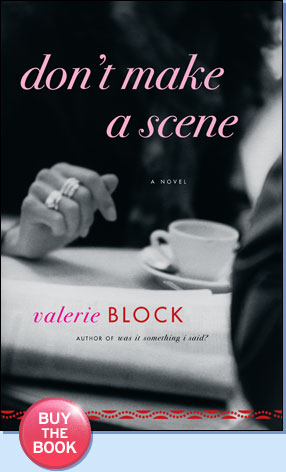
Announcement: Samara L. of Elyria, OH who receives a copy of Valerie Block’s new book, Don’t Make A Scene!
Here is part two of my conversation with Valerie:
Chica Lit: You make references to Ingrid Bergman throughout the book. What qualities of Ms. Bergman appealed to you and how did she figure so prominently in the story?

Valerie: In the book, I used movie stars and directors to reflect on what is happening in the life of one of my main characters, Diane Kurasik, who is a movie lover. Diane is nearing 40 and still single, so a film like Indiscreet, where Bergman plays an actress in her 40s who is cheerful and single without apologies, appeals to her. Bergman was also one of the few people who stood up to David O. Selznick, who sat her down with a stylist when she first came to Hollywood, and told her how they would tweeze her eyebrows, fix her teeth and put her on a diet. She told him, “If you don’t like the way I look, what am I doing here?” And that was the end of that. When Diane is feeling pressure to conform, she recalls this meeting and finds strength to resist.

I wasn’t able to include all my favorites – only the ones that had something to do with what was going on with the story. So it was Katharine Hepburn who found her way into the book, because of her performance in Summertime, another film dealing with a single woman struggling to reconcile what she wants for herself, and her actual place in the world. Glenda Jackson made it in, because of her harassed intelligence, and Lucille Ball, who became personally and professionally involved with an impossible Cuban. Many others, too: Judy Garland, Bette Davis, Joan Crawford, Carole Lombard.

Chica Lit: Do your family and friends read your work, looking for themselves in your characters? (Mine do and they never get it right!)

Valerie: My friends and family members often bring up bits that I’ve used where they see direct parallels, and it’s useless to argue that I’ve radically changed the details, the context and/or the outcome. At this point, family members have mentioned some episodes that I’ve created from scratch as if they actually happened. These books take on a life of their own.

Chica Lit: How much did your husband influence the character of Vladimir?

Valerie: There are two main male characters in the book, both Cuban, and I would say my husband influenced both of them, but neither one of them is completely him. I wanted to write about my husband’s world, which I think any Cuban in exile would recognize, without writing about him. Alexis read every draft. He made sure I got everything right, not just the Cubanidad. But you know that it’s fiction — some might say science fiction — because I’ve written about a Cuban man who doesn’t want to talk, an affliction from which my husband does not suffer, I assure you.

For more information about Valerie and her books, please visit her website!

Between The Pages With Lisa Wixon

She only planned to stay a week in Cuba, but came home a year later.

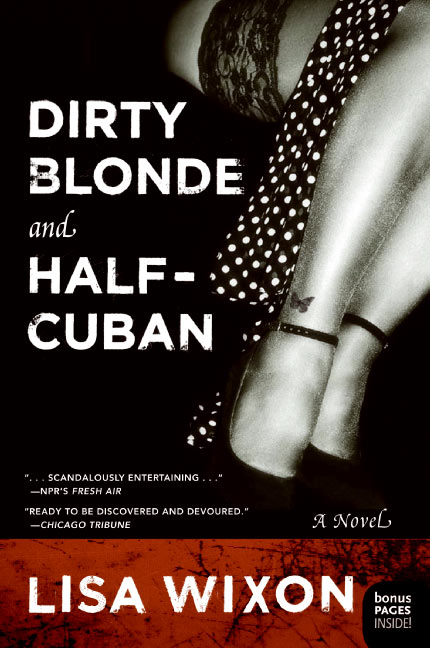
Lisa Wixon had saved enough money to travel the world but when she arrived in Cuba, via Panama City, she befriended a young woman who revealed that she was a jinetera (literal translation: a jockey), a young professional woman who earns money by acquiring foreign boyfriends, much like a 17th century courtesan or royal mistress. Lisa turned her experience among jineteros into a novel, Dirty Blonde and Half Cuban.

I’ve owned this book for about a year and when I finally set a time to interview Lisa, I sat down to read it. Four hours later when I finished the book, I had to go back and start it all over again because I didn’t want to leave those characters behind. Also, Lisa told me that there wouldn’t be a sequel.

Chica Lit: How long did it take you to write this novel and what was your process?

Lisa: The first 50 pages took two to three months. I wrote the last 200 to 250 pages in ten weeks and did nothing nothing else. I wrote from 10P till 930A. It was the only way to create the world.

Chica Lit: Pardon me for asking, but how do you support yourself with a writing schedule like that?

Lisa: Travel writing is my main occupation. I take in PR jobs, just to make enough money to take off and think and write. It’s hard. Isolating myself is not something that I love because I’m an outgoing person. With this novel and the one I’m writing now, I have to really isolate myself. Torture is the only way I get it done.

Chica Lit: How did you research your book?

Lisa: The story of Alysia going to Cuba is fiction entirely. I held myself to nonfiction standard talking about issues and facts such as how much women make compared to how much a pair of tennis shoes cost.

Chica Lit: Why did you use an American character like Alysia in telling this story?

Lisa: I knew that people in America would understand her. There are so many similarities between Americans and Cubans in that they are very hard working and they place a high value on education. I wanted to use Alysia as an American woman with education and an upper class background who is forced to live the life as a jinetera to survive in Cuba.

Chica Lit: One of the things I loved in the story were the sex scenes because during those moments, Alysia seems to suddenly wake up and realize what she’s gotten herself into. It’s like she realizes she fell down a rabbit hole.

Lisa: The Cuban women who are jineteras feel that, too. They ask, why have I done this? I’m a doctor, why do I have to do this?

Chica Lit: How did your family react to the novel? Did they wonder what you had been doing in Cuba all that time?

Lisa: Because this story is so far out from my real life experience, they didn’t think anything is true. My mom tells people, “Read my daughter’s book but wear sunglasses!”

Chica Lit: What was your life in Cuba like?

Lisa: After I befriended her (the young jinetera), I moved in with her family. I met other jinoteros and I’d go out at night with them and watched them get picked up. I spent time with them and their boyfriends and girlfriends from other countries.

Chica Lit: How did you feel watching people you came to love, sell their bodies?

Lisa: It was really difficult, a very emotional time for me. I often had to question why I was there putting myself in an emotionally difficult situation and tried to compartmentalize it there. I had to tell myself that me being there would not change the consequences; this would happen if I was there or not. When I came back, it took me a long time to process it. Anger and a sense of indignation fueled me to write this book.

Chica Lit: How difficult was it to get into the heads of your characters?

Lisa: It is almost impossible not to feel what the characters feel. The intensity with which I lived in Alysia’s skin while writing the story was one of reasons why I procrastinated after the book deal. I had to cut out the rest of the world to go back into Cuba at my desk.

Check out Lisa’s novel, Dirty Blonde and Half Cuban.